
Anchoring & chemical fixing
Chemical Anchoring for Threaded Rods
Threaded rods bonded into existing concrete with two-part adhesive cartridges — holes drilled, cleaned, injected and cured to the system data for the substrate temperature.
What this service covers
Chemical anchoring sets a threaded rod into a drilled hole in concrete with a two-part adhesive, so the rod transfers load into the concrete through a bond along its embedded length rather than through expansion. The cartridge, the static mixer and the injected volume are all part of the system, and the capacity depends on the adhesive being mixed correctly, the hole being cleaned properly and the rod being left undisturbed until the adhesive has fully cured. It is the usual choice where edge distances are tight, where the concrete is cracked, where the fixing sits close to reinforcement, or where the rod has to reach a depth a mechanical anchor cannot. AKEN drills, cleans, injects and sets the rod to the system manufacturer's instructions, and does not load the fixing until the full-cure time for the substrate temperature has elapsed.
A chemical anchor is a bonded connection, and nearly everything that decides its capacity happens before the rod goes in. The adhesive is not a gap filler: it bonds the rod to the concrete along the full embedment, and any dust left on the wall of the hole sits between the adhesive and the concrete it is supposed to grip. That is why the cleaning sequence — brushing and blowing, in the order and number of cycles the manufacturer specifies — is the single biggest factor in whether the fixing reaches its published value.
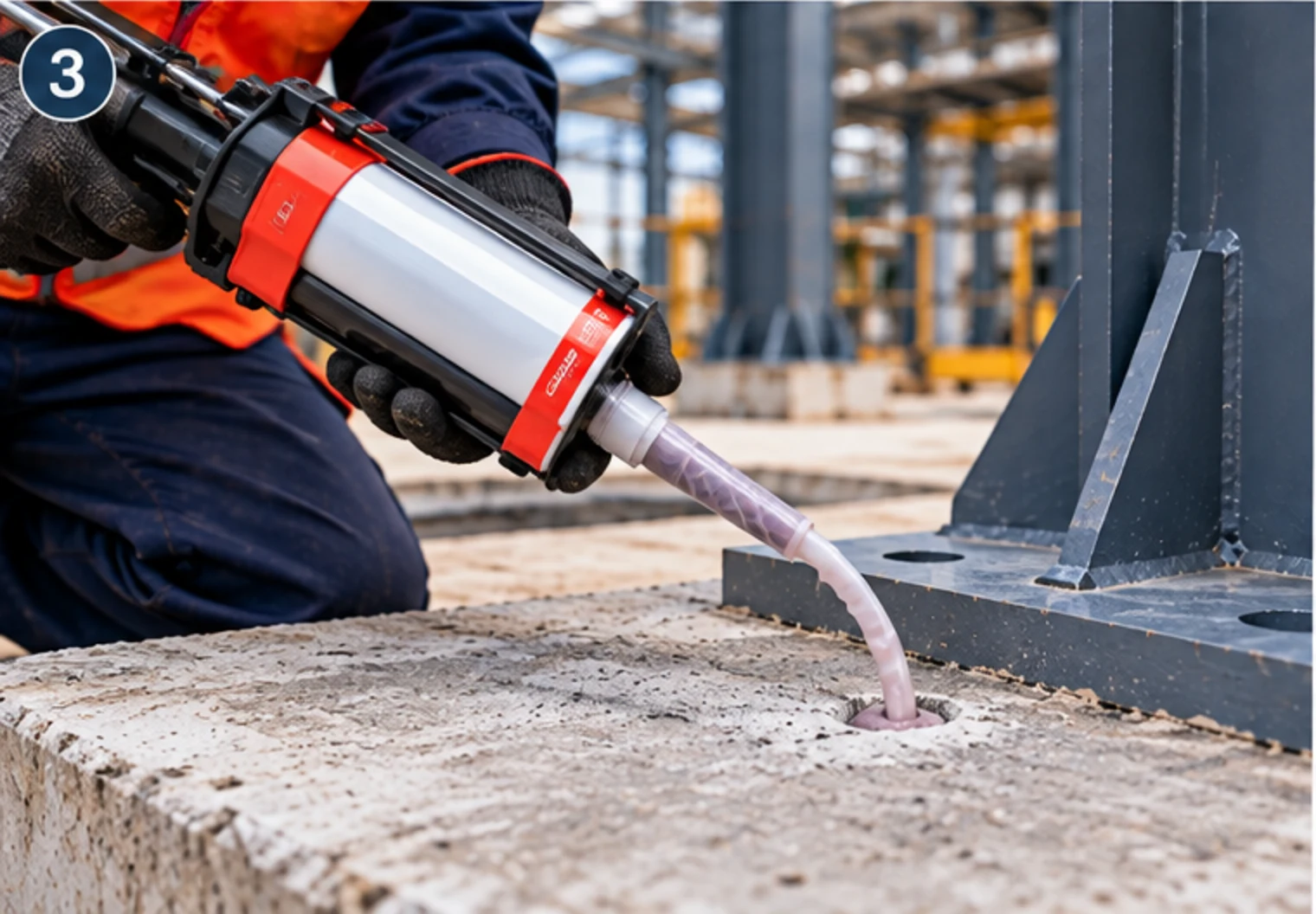
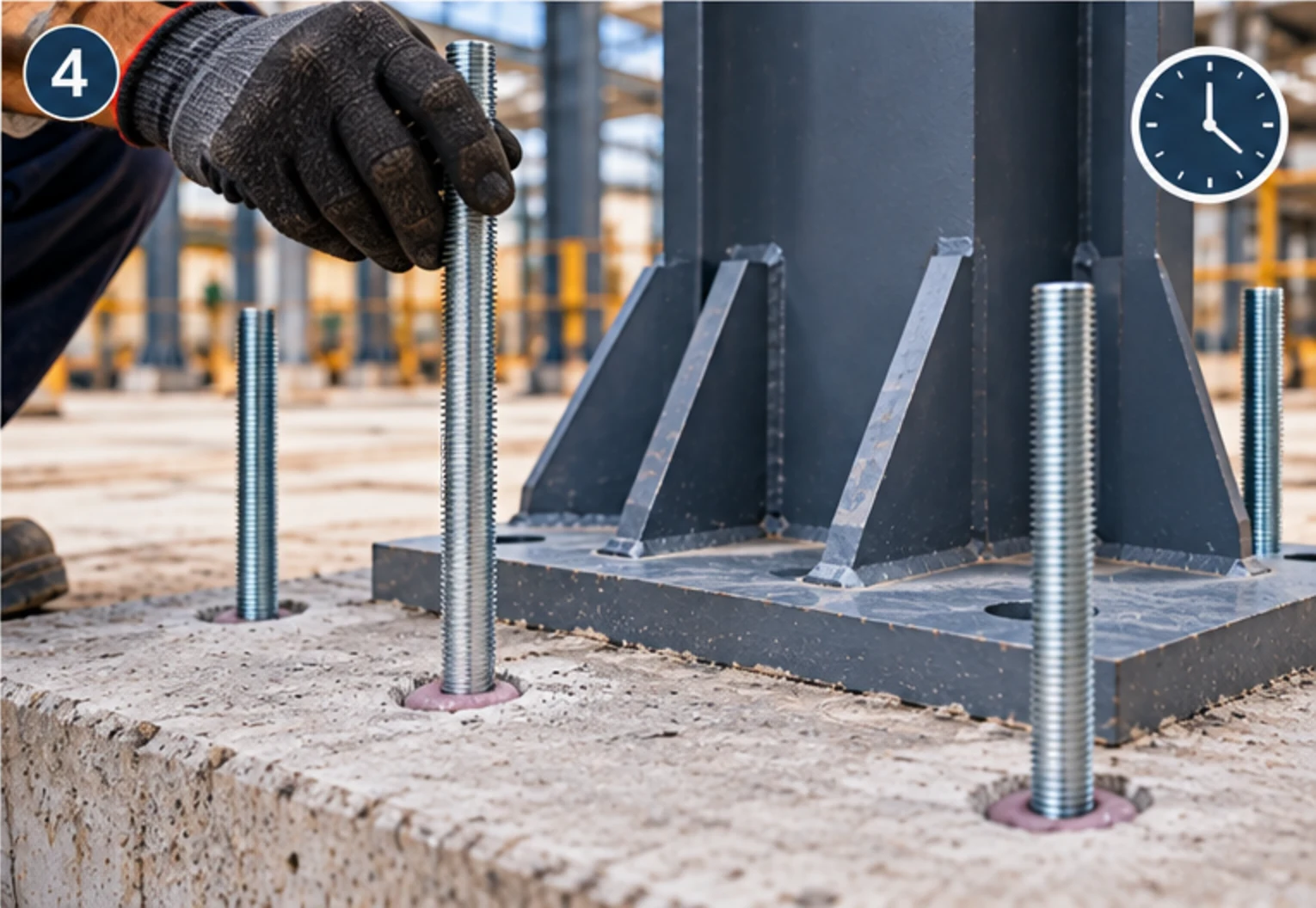
The cartridge is a system with its own rules. Two components are mixed in a static nozzle as they are extruded, and the first part of that extrusion is not fully mixed, so the manufacturer specifies a volume to discard. Injection starts at the bottom of the hole and the nozzle is withdrawn as the hole fills, so no air is trapped behind the adhesive. A new nozzle, and any interruption long enough for the material in the nozzle to gel, means a fresh nozzle and a fresh discard. Loading the rod before full cure is the other common failure: the gel time and the cure time both lengthen as the concrete gets colder, so the timing is read from the cartridge data for the measured substrate temperature rather than from a rule of thumb.
The systems we install are selected from internationally recognised manufacturers — HILTI, fischer, Simpson Strong-Tie, MKT and Rawlplug are among those commonly specified and installed on Indian industrial sites, with the system and its approval governing the detail. That list does not settle the selection: the adhesive grade, the rod, the embedment and the design method all follow from the substrate condition, whether the concrete is cracked or uncracked, the application and the loading, the embedment depth available, any fire or approval requirement, and the manufacturer's published data for that product. AKEN holds no dealership, distributorship or certification with any of these manufacturers. What governs the fixing is the approval document that comes with the system being installed, and it has to fit the job.
Scope of work
What we actually carry out under this service. Anything outside this list is quoted as a separate line rather than absorbed into a lump sum, so you can see what you are paying for.
- Selection of the adhesive grade and rod from the substrate, the loading and the manufacturer's published data
- Setting out positions against the reinforcement scan and the edge distances the system approval requires
- Drilling to the specified diameter and embedment depth, with the drilling method the system specifies
- Hole cleaning — brushing and blowing in the specified sequence, with the hole capped or plugged until injection
- Checking the cartridge, nozzle and adhesive temperature, and discarding the unmixed volume at every new nozzle
- Injecting from the base of the hole with the nozzle withdrawn as the hole fills, so no void is trapped
- Inserting the rod to its marked embedment with a slow twisting motion, and holding it true while the adhesive gels
- Respecting the gel and full-cure times for the measured substrate temperature before any load is applied
- Leaving the correct thread projection for the fixture and protecting it during the cure and afterwards
- Recording adhesive product and batch, hole depth, embedment, temperature and cure time for the handover file
Technical capability
Materials, components and methods. Where a figure would be quoted, the governing factor is named instead — a diameter or a tonnage is a design outcome, not a catalogue item, and the number only means something alongside the loads behind it.
- Adhesive systems
- Two-part epoxy, epoxy acrylate and hybrid cartridges in the grade the application needs, including crack-approved and water-tolerant types where the specification calls for them
- Hole cleaning
- Purpose-made brushes and blowing equipment used in the sequence and cycle count the cartridge data specifies — this step, not the product, decides most outcomes
- Drilling
- Hammer drilling to the specified diameter and depth, with core drilling and hole roughening where the system requires it
- Rod
- Threaded rod in the grade and finish the exposure demands, degreased before it goes into the hole — oil or scale on the rod is a bond failure
- Embedment
- Set from the system data for the rod diameter, the concrete condition and the loading, and marked on the rod before insertion so it can be checked
- Curing
- Gel and full-cure times read from the cartridge data for the measured substrate temperature, with no load and no movement before full cure
- Overhead work
- Support collars or the manufacturer's overhead method, so the adhesive stays in an upward hole while it cures
- Verification
- Proof load testing on a sample where specified, with results recorded against the fixing position and product batch
How the work is executed
- 01
Selection and setting out
Substrate condition, hole and rod size, embedment and adhesive grade taken from the system data, positions set out against the reinforcement scan, and edge distances checked against the approval.
- 02
Drilling
The specified bit to the specified diameter and depth, by the method the system allows. Hole depth is checked before cleaning, because a hole cleaned and then deepened has to be cleaned again.
- 03
Cleaning
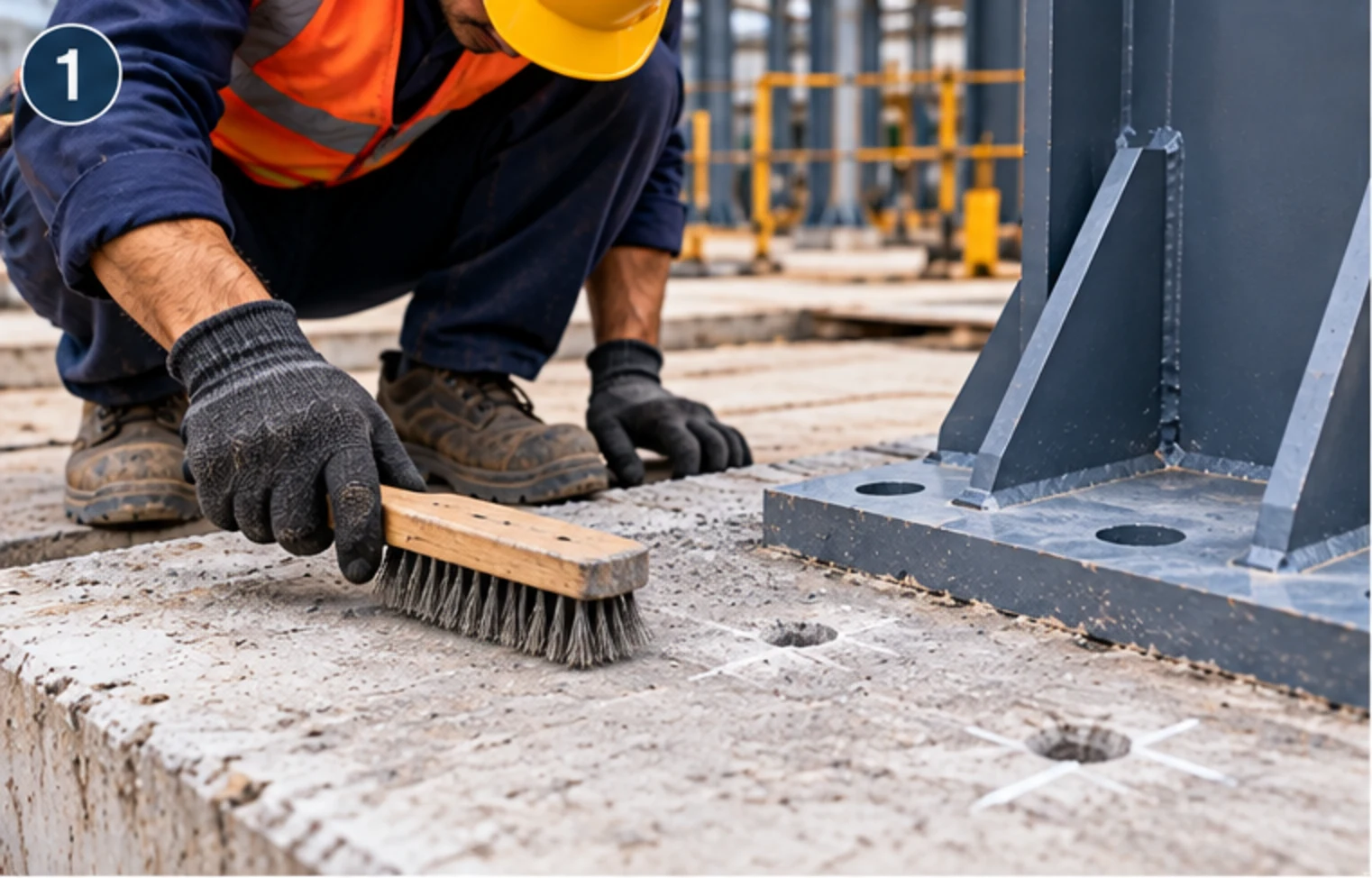
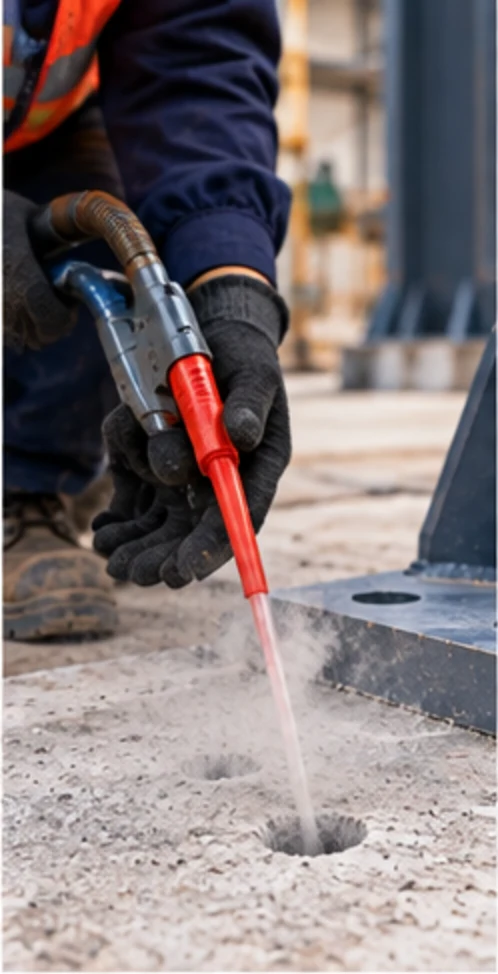
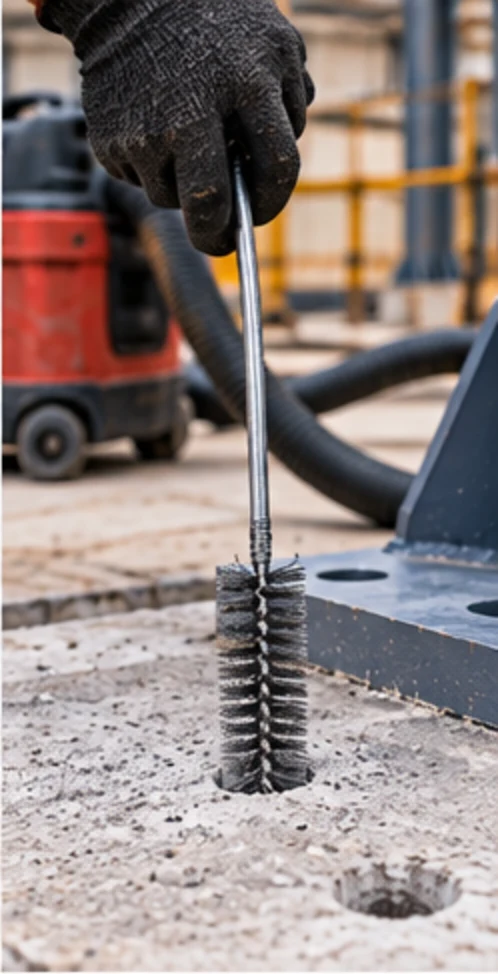
Brushing and blowing in the specified cycles, from the base outward, with the hole plugged afterwards. Every hole is cleaned immediately before injection rather than all of them at the start of the shift.
- 04
Injection
A fresh nozzle, the unmixed volume discarded, and adhesive injected from the base of the hole with the nozzle withdrawn as it fills. The volume comes from the hole size, not from judgement.
- 05
Rod insertion and cure
The rod is pushed in slowly with a twisting motion to its marked embedment, and held true until the adhesive gels. Nothing is hung on it, tightened against it or knocked until full cure for that temperature has passed.
- 06
Verification and record
Projection and alignment checked, proof loaded where the specification requires it, and the product, batch, depth, temperature and cure time recorded so the fixing can be defended later.
The work, step by step
Illustrative images showing the sequence and the type of work involved. They are not photographs of a specific completed AKEN project — for those, see the project photographs.
01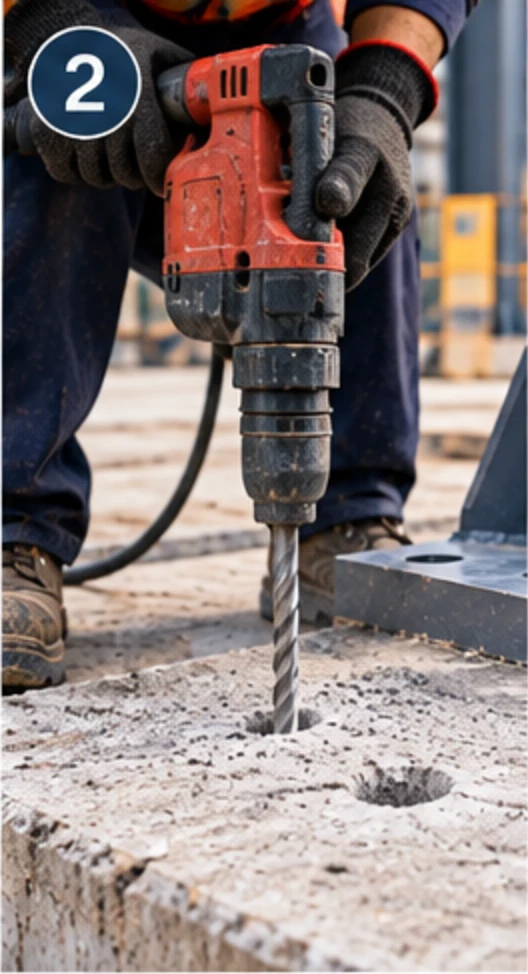 02
 03
 04
 05
 06
Where this is used
We work for plant and procurement teams, EPC contractors and owner-operators across power, cement, mining, manufacturing, warehousing and infrastructure. Much of it is inside a running plant, which sets the terms of the job.
- Threaded rods for equipment and pipe supports where edge distances are tight
- Fixings into cracked, repaired or previously loaded concrete
- Base plates and brackets in existing slabs and walls
- Overhead supports in plant rooms and industrial buildings
- Fixings close to reinforcement where a mechanical anchor cannot be placed
- Retrofit work where cast-in fixings are absent or unusable
- Exposed fixings that need a stainless rod for corrosion resistance
Why AKEN
Cleaning controlled, not assumed
The cleaning sequence is specified per system, followed, and recorded. It is the one step that decides the capacity and the one step that is invisible on the finished fixing.
Cure time read from the data
Substrate temperature is measured at the hole and the cure time taken from the cartridge data for that temperature. A cold store slab and a sunlit roof slab are not the same job.
Scanning before drilling
Reinforcement and services are located first, so a fixing is moved on the drawing rather than through a bar in a structural member.
Records that survive an audit
Product, batch, hole depth, embedment, temperature and cure time, plus any proof load results, compiled as the work proceeds rather than reconstructed at the end.
Same discipline on small schedules
A dozen rods for a pipe support get the same cleaning, nozzle and cure discipline as a full base plate group, because the load per rod is no smaller.
Our safety controls are set out in full at site safety, including the photographs we withdrew because they showed unsafe work.
FAQ
Chemical Anchoring: questions buyers ask
Why is hole cleaning so important for chemical anchors?
Because the bond is between the adhesive and the concrete, and drilling leaves a layer of dust on exactly that surface. The adhesive then grips the dust rather than the concrete, and the fixing fails at that interface at a fraction of its design value. Brushing and blowing in the specified cycles is not a courtesy step; it is the difference between the published capacity and a rod that pulls out.
How long before a chemical anchor can be loaded?
Until the full-cure time for the substrate temperature has elapsed. That time is read from the cartridge data for the temperature actually measured at the hole, because a cold store slab, a shaded slab in winter and a sunlit roof slab do not cure at the same rate. Both the gel time and the full-cure time lengthen as the concrete gets colder, and a rod disturbed during gel will not recover its capacity.
How much adhesive should be injected into a hole?
The hole volume follows from its diameter and depth, and the manufacturer gives the number of cartridges or a graduated scale for a given rod and embedment. Inject from the bottom of the hole and withdraw the nozzle as it fills, so no voids are trapped behind the adhesive. Overhead holes take a different technique, and the manufacturer's overhead method has to be followed rather than adapted.
Why is the first part of the cartridge discarded?
Because the two components are not properly mixed until the adhesive has travelled through the static nozzle, so the initial extrusion is off-ratio and will not cure as designed. A new nozzle means a new discard, and any interruption long enough for the material in the nozzle to start gelling means a new nozzle as well. Extruding that material into the hole to save waste is a false economy.
Can a chemical anchor be used in a wet hole?
Only if the system is a water-tolerant or underwater grade, and even then the hole condition has to be what that product's data assumes. A standard cartridge in a wet hole may not reach its published strength at all, and some adhesives are affected by water before they set. The hole condition is checked and recorded before injection, and the product is chosen to suit it rather than the other way round.
Can any threaded rod be used as a chemical anchor?
No. The rod diameter, grade and finish have to be what the system's data covers, and the rod must be clean and free of oil, loose scale and zinc flake before it goes in. Some systems specify a particular rod grade, and some use a chisel-pointed rod for easier insertion. An unidentified or greasy rod is a bond failure waiting to happen even when the drilling and cleaning were perfect.
How deep does a chemical anchor rod have to go?
To the effective embedment the system data gives for that rod diameter, that concrete condition and that loading. Greater embedment generally increases capacity until the steel or the concrete governs instead, but the published value applies at the stated depth. A shallower hole because the drill met something is a different fixing, and the design has to be re-run rather than the rod shortened.
Can a chemical anchor be installed overhead?
Yes, using the technique the manufacturer specifies — usually a support collar, a retaining device or a thickened adhesive that stays in an upward hole. Injection upward, a rod that sags before the adhesive gels, and adhesive running out of the hole are the three risks, and all three are managed by following the overhead method. It is not simply an inverted version of a floor fixing.
How does chemical anchoring compare with a mechanical anchor?
A chemical anchor bonds along the embedment, so it usually tolerates closer edge distances, closer spacing, cracked concrete and greater depths than an expanding clip. A mechanical anchor is quicker, immediately loadable and easier to inspect visually, but it depends on an accurately drilled hole and on having enough sound concrete around it. The choice follows from the substrate, the loading and the approval, not from preference.
Does a chemical anchor need a fire assessment?
Sometimes, and the requirement comes from the building rather than the fixing: what the structure has to do in a fire determines whether the anchor needs a fire assessment, and not every adhesive system has one for the required period. That requirement should be stated at enquiry. Where it applies, the system is chosen from the products that hold the relevant assessment for that embedment and loading.
Related services
Next step
Have an industrial project in mind?
Discuss your requirement with AKEN. Send the site location, the scope and the date you are working towards, and we will tell you what we need to quote it properly — usually a site visit, scheduled within 72 hours.
+91 82800 76864 · contact@aken.firm.in