
Anchoring & chemical fixing
Wedge Anchor Installation in Concrete
Mechanical expansion anchors set out, drilled, cleaned and torqued to the published data for the system — for base plates, brackets and supports in existing concrete.
What this service covers
A wedge anchor is a mechanical fixing that carries load by expansion: torque on the nut pulls a tapered cone up through an expansion clip, which is driven out against the wall of the drilled hole, so the load passes into the concrete through bearing and friction rather than through a bond. It suits base plates, brackets, pipe supports and similar fixings into sound concrete where the fixing can be drilled and torqued from an accessible face. The capacity published for a given anchor applies only inside the conditions that data assumes — a minimum edge distance, a minimum spacing, a stated embedment depth, a stated concrete strength and a cracked or uncracked assumption. AKEN sets out the positions, drills to the specified diameter and depth, cleans the hole, inserts the anchor through the fixture and torques it to the value the manufacturer gives, with the torque wrench in calibration and the installation recorded.
The mechanism is simple and unforgiving. The anchor does not grip because it is a tight fit in the hole; it grips because the clip is expanded into the concrete by torque, and the concrete then resists through bearing. That means the value of the fixing is created on site by the person holding the drill and the wrench rather than at the factory. Two anchors out of the same box, into the same concrete, fitted by two different people, can end up with very different capacities.
The hole is where installations go wrong. The bit has to be the diameter the anchor was designed for, because an oversized bit, a worn bit or a hole wallowed by a drill that wandered gives the clip nothing to expand against. The depth has to suit the embedment the data assumes, because the cone must have its full travel. The hole has to be drilled square to the surface, cleaned of dust so the clip beds on concrete rather than on powder, and set out to the edge distance and spacing the data requires, since an anchor placed too close to an edge breaks the concrete out instead of holding.
The systems we install are chosen from internationally recognised manufacturers — HILTI, fischer, Simpson Strong-Tie, MKT and Rawlplug are among those commonly specified and installed on Indian industrial sites, with the system and its approval governing the detail. That list does not make the choice: the anchor is selected against the substrate and whether the concrete is cracked or uncracked, the application and the loading, the embedment depth actually available, the fire and approval requirements of the building, and the manufacturer's published data for that product. AKEN is not an authorised dealer, distributor or certified installer for any of these manufacturers; what governs the fixing is the approval document for the system being installed, and it has to match the job.
Scope of work
What we actually carry out under this service. Anything outside this list is quoted as a separate line rather than absorbed into a lump sum, so you can see what you are paying for.
- Setting out anchor positions from the approved drawings, with the edge distances and spacings the anchor data requires
- Scanning for reinforcement and embedded services before drilling, and re-siting a fixing that clashes with either
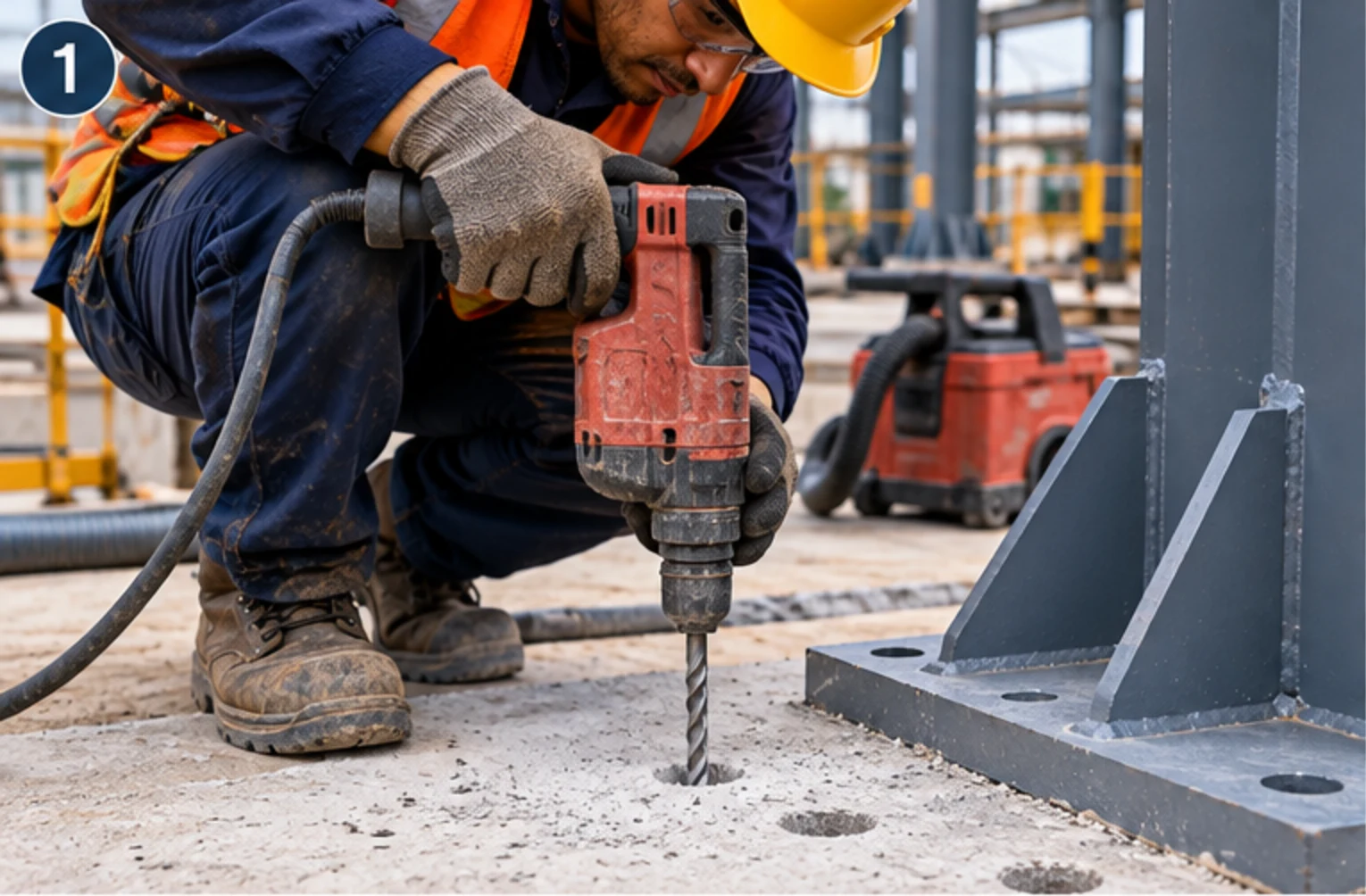
- Drilling to the specified diameter and depth with a hammer bit in good condition, held square to the surface
- Checking hole diameter, hole depth and embedment against the anchor data before anything is inserted
- Hole cleaning by brushing and blowing to the anchor manufacturer's instruction, with the hole covered until insertion
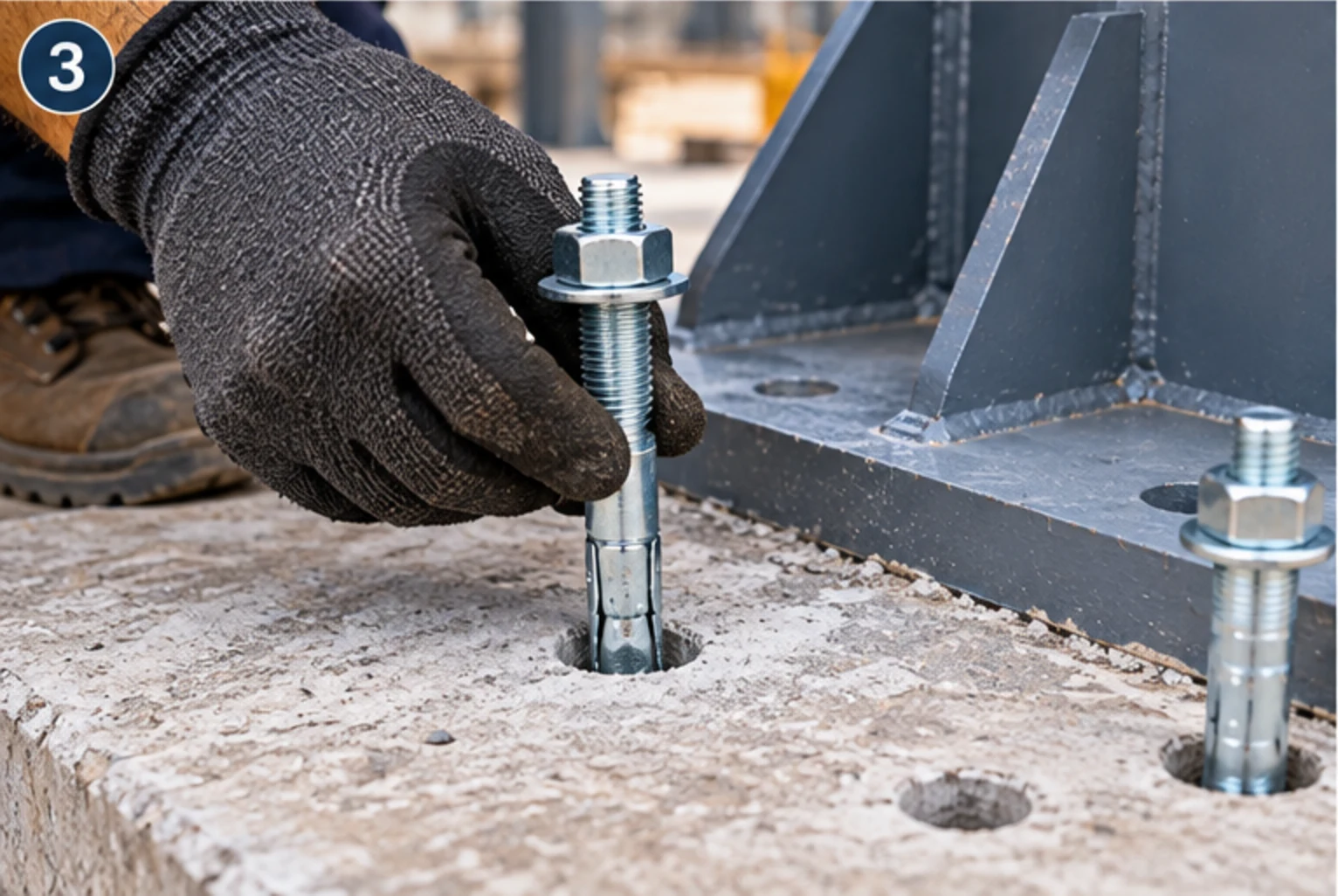
- Inserting the anchor through the fixture and driving it to the embedment the data assumes
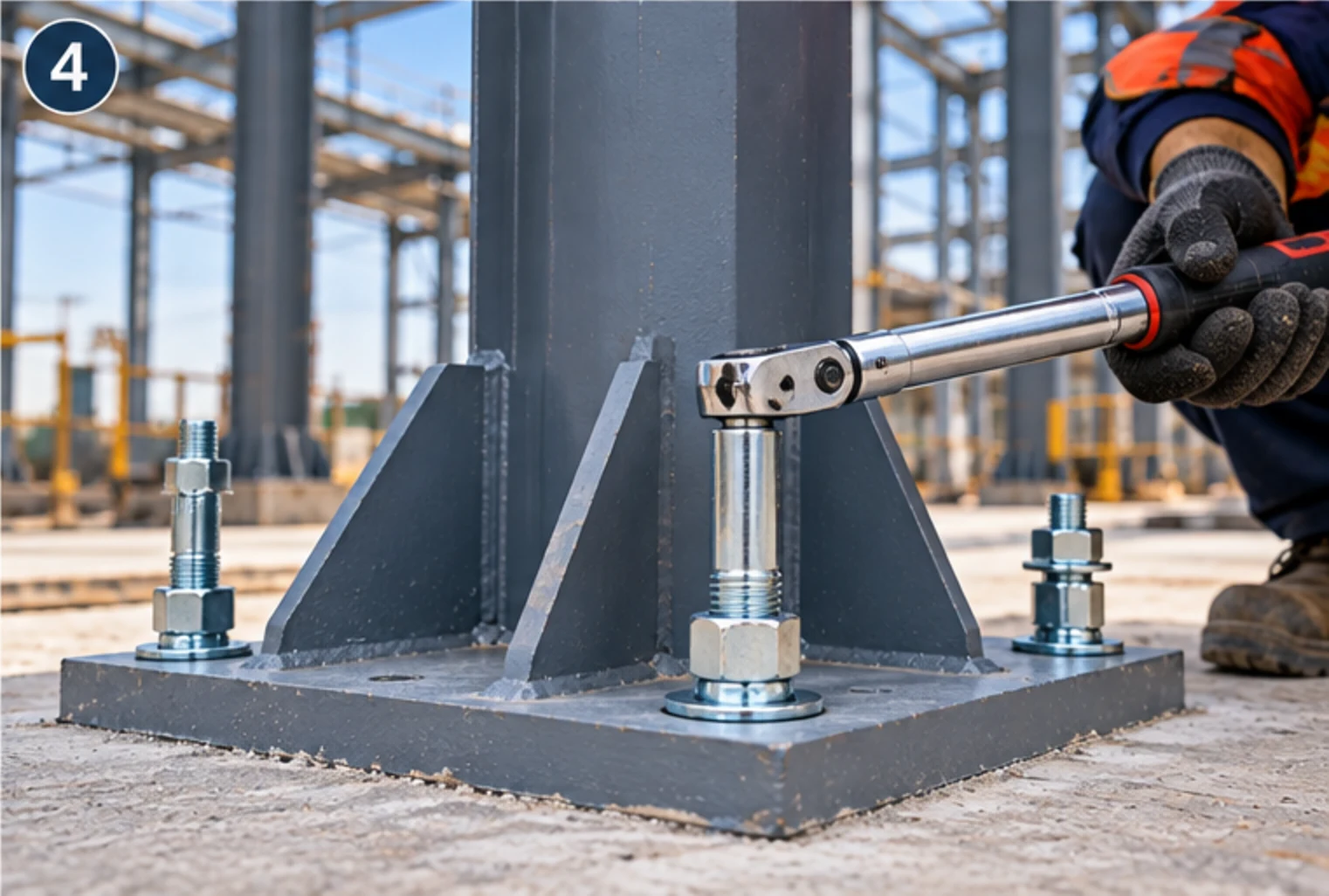
- Torqueing to the manufacturer's specified value with a calibrated wrench, in the sequence the fixing group needs
- Verification — checking the fixture is pulled down evenly, and proof load testing where the specification calls for it
- Recovery of mis-set or rejected fixings, with the position re-drilled or moved rather than the anchor forced
- Recording anchor type, diameter, embedment, applied torque and test results for the installation handover file
Technical capability
Materials, components and methods. Where a figure would be quoted, the governing factor is named instead — a diameter or a tonnage is a design outcome, not a catalogue item, and the number only means something alongside the loads behind it.
- Anchor types
- Torque-controlled expansion anchors, sleeve anchors and drop-in or screw anchors, selected for the fixture, the concrete and the loading rather than for availability
- Hole quality
- Correct bit diameter, a bit that is not worn out, and a drill held square — the expansion happens against the hole wall, so the hole is the mechanism
- Hole cleaning
- Brushing and blowing in the sequence the manufacturer gives; dust under the clip is lost capacity, not an untidiness issue
- Torque control
- Calibrated torque wrenches, with the setting taken from the data sheet for that anchor diameter and embedment and applied in the right order within a group
- Edge distance and spacing
- Set out from the published values for the embedment used, because a group of anchors does not simply add up when they are too close together
- Rebar avoidance
- Cover meter or scanning before drilling, so existing reinforcement is neither cut nor left touching the new anchor
- Corrosion protection
- Zinc-plated, hot-dip galvanised or stainless anchors, chosen for the exposure the fixing will actually see rather than for the standard specification
- Verification
- Proof load testing on a sample of installed anchors where the specification or the approving authority asks for it, with results recorded against the position
How the work is executed
- 01
Setting out and scanning
Positions marked from the approved layout, edge distances and spacings checked against the anchor data, and the concrete scanned for reinforcement and services. A fixing that cannot be placed legally is a design conversation, not a drilling improvisation.
- 02
Drilling
The specified bit, in good condition, held square, to the depth that gives the embedment the data assumes. Drill depth is checked as the work proceeds, because a short hole means the cone never completes its travel.
- 03
Cleaning
Brushing and blowing to the manufacturer's sequence, with the hole covered afterwards so dust and water do not go back in. This step takes a few seconds and is the one most often skipped.
- 04
Insertion and torqueing
The anchor is passed through the fixture and driven to embedment, then torqued to the specified value with a wrench in calibration. Groups are brought down evenly rather than one bolt at a time.
- 05
Verification and record
Each fixing checked for a seated washer and a pulled-down fixture, proof loaded where the specification requires it, and the type, embedment and torque recorded so the installation can be audited later.
The work, step by step
Illustrative images showing the sequence and the type of work involved. They are not photographs of a specific completed AKEN project — for those, see the project photographs.
01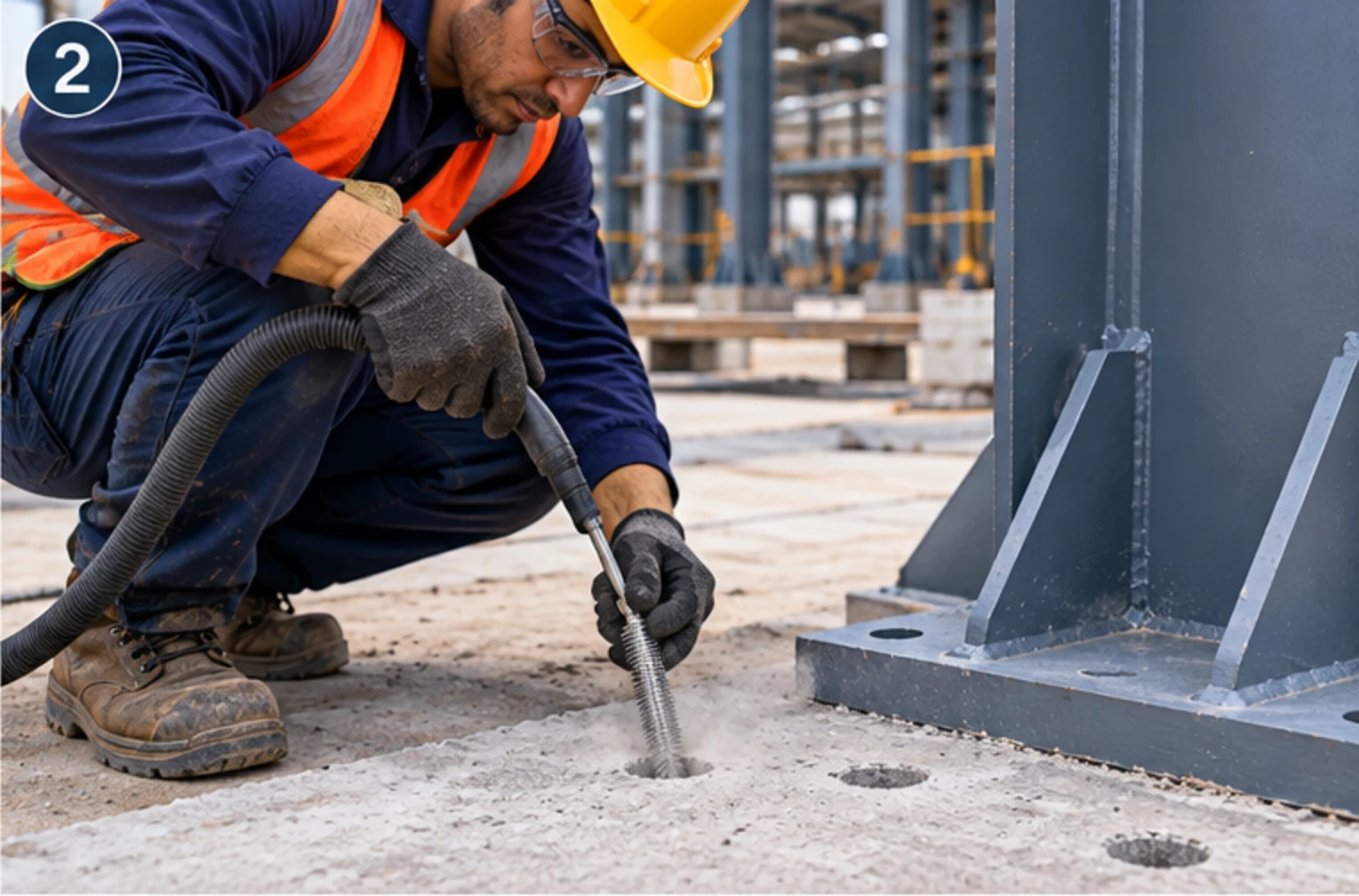 02
 03
 04
Where this is used
We work for plant and procurement teams, EPC contractors and owner-operators across power, cement, mining, manufacturing, warehousing and infrastructure. Much of it is inside a running plant, which sets the terms of the job.
- Base plates for mechanical and process equipment
- Pipe supports, hangers and cable tray brackets
- Structural steel brackets fixed into existing concrete
- Handrails, ladders and walkway supports
- Machine beds, pump foundations and skid fixings
- Retrofit fixings where cast-in provisions were missed
- Storage racking and material handling fixings
Why AKEN
Set-out before drilling
Edge distances and spacing are checked against the anchor data before a bit touches the concrete. Once a hole is drilled in the wrong place it cannot be made good by drilling harder.
Torque recorded, not estimated
A calibrated wrench and a written value, applied and signed off. Feel is not a method, and a fixing that was never torqued has none of the capacity the drawing assumes.
The hole treated as the mechanism
Bit diameter, bit condition, squareness, depth and cleaning are held as quality points rather than as preparation. That is where a mechanical anchor gains or loses its published value.
Rebar scanning as standard
Scanning before drilling protects the structure and the fixing at once. Cutting existing reinforcement to make room for a bolt is not a site decision.
Anchoring treated as a selection
Whether a mechanical anchor is right at all is settled first, from the substrate, the loading, the embedment available and the approvals. Sometimes the honest answer is a different system.
Our safety controls are set out in full at site safety, including the photographs we withdrew because they showed unsafe work.
FAQ
Wedge Anchor Installation: questions buyers ask
How does a wedge anchor hold in concrete?
By expansion. Turning the nut against the fixture pulls the stud up, and a tapered cone drives an expansion clip outward into the concrete. The load then passes into the concrete by bearing and friction over the embedded length rather than by adhesion. Nothing is glued, which is also why the fixing can be dismantled later — and why the quality of the hole matters more than anything the factory did.
What torque should a wedge anchor be set to?
The value the manufacturer publishes for that anchor diameter and embedment, applied with a torque wrench that is in calibration. Under-torque means the clip has not been driven fully out and the anchor is not carrying what the data says. Over-torque can shear the stud or spin the anchor in the hole and destroy the setting. There is no reliable way to judge it by feel.
What happens if the drilled hole is too big?
The anchor loses its mechanism. The clip needs an accurately sized hole to expand against, and an oversized or wallowed hole lets the cone travel without generating bearing pressure, so the anchor pulls out far below its published value. It cannot be rescued with a larger anchor or by tightening harder. The fixing is abandoned and drilled again at a new position.
How close to an edge can the anchor be?
No closer than the edge distance published for that anchor at that embedment, in the concrete strength actually present. Closer than that, the concrete fails by breaking out a cone rather than the anchor failing, so the capacity drops sharply and without warning. Where the layout will not allow the edge distance, the answer is a different fixing or a revised detail, not a shorter anchor.
Does it matter whether the concrete is cracked?
Yes, and it changes which anchor is used. Cracks alter the stress field around an expanded clip, so many anchors carry separate published values for cracked and uncracked concrete, and some are not qualified for cracked concrete at all. Whether the concrete at the fixing will be cracked depends on the structure and its loading, which is a design question rather than something settled on site.
Can a wedge anchor be installed overhead, in a soffit?
It can, because the mechanism does not depend on gravity, but the installation does. Drilling overhead, cleaning the hole and holding the anchor while it is torqued all need access and usually a second person, and dust falls into the operator's face. The fixture also has to be held or propped until the anchor is torqued, so the sequence needs temporary support.
Can a wedge anchor be removed and reused?
It can be unbolted, and many types can be driven through and withdrawn, but it should not be reused: the clip has already been deformed and the hole it came out of is damaged. In practice a removed anchor means a new hole, or a chemical anchor at the same position if the hole can be redrilled and properly cleaned. Where removal is likely, that is worth saying before the fixing type is chosen.
Why did the anchor spin instead of tightening?
Usually because the hole is too large for the clip to bite, or because the drilling broke into a void, a mortar joint or the side of a reinforcement bar in a way that the set-out did not reveal. Once an anchor spins it has no capacity and cannot be recovered by re-torqueing. It is cut out or driven through, the position is moved or redrilled, and the cause is recorded so the rest of the group is checked.
Are wedge anchors suitable for every concrete fixing?
No. They suit sound concrete with room for the embedment and the edge distances. Heavy vibrating machinery, thin slabs, hollow block masonry, tight edge distances, cracked concrete and fire-rated situations each point towards a different fixing or a different approval, and some of those need a chemical system or a cast-in detail. The selection is made from the substrate and the loading, not from what is on the van.
How do I know the anchors were installed correctly?
By the record. Anchor type and its approval, the bit diameter used, the drilled depth achieved, the cleaning method, the torque value applied and the wrench calibration, plus any proof load test results where testing was specified. That record is what a client or an auditor can check months later, and it is compiled as the work proceeds rather than reconstructed afterwards.
Related services
Next step
Have an industrial project in mind?
Discuss your requirement with AKEN. Send the site location, the scope and the date you are working towards, and we will tell you what we need to quote it properly — usually a site visit, scheduled within 72 hours.
+91 82800 76864 · contact@aken.firm.in