
Erection & industrial installation
Mechanical Equipment Erection Contractor
Receipt, lifting, setting, grouting and alignment of pumps, fans, blowers, gearboxes and vessels — with soft foot corrected before the piping is connected.
What this service covers
Mechanical equipment erection is the installation of the machines and vessels inside a plant — pumps, fans, blowers, compressors, gearboxes, heat exchangers and tanks — onto their foundations, set, aligned and handed over ready for commissioning. It is bought by plant owners, project teams and EPC contractors who need the equipment set true rather than merely bolted down, because a machine out of alignment damages its own bearings and coupling within weeks of start-up. AKEN handles receipt inspection, lifting to a written lift plan, levelling, shimming and grouting, soft-foot correction, shaft and coupling alignment, and the checks at the piping interface before the suction and discharge lines are connected.
Equipment erection looks like rigging work with paperwork attached. It is not. The rigging moves a machine from a lorry to a plinth; everything that determines whether the machine lasts happens afterwards, in the order the alignment takes: base plate levelled, sole plates shimmed, grout placed and cured, soft foot found and corrected, coupling aligned and recorded, and only then the piping brought to the nozzles.
The order matters because each step can destroy the one before it. Grout poured under a base plate that is already distorted will hold that distortion for the life of the machine. A coupling aligned without a soft-foot check will read true with the bolts slack and untrue once they are tight. Piping pulled into place with flange bolts instead of being cut to suit will load the casing, and the alignment taken before that happens was measuring a machine that no longer exists.
Much of this work happens inside operating plants, where the equipment is replacing something already running rather than starting a new process. That changes the planning: access is through an existing bay, lifting is often over live pipework or cable trays, hot work needs a permit and a fire watch, and the tie-in has to be finished inside a shutdown window that the client has already fixed. AKEN plans the sequence backwards from that window, so the machine is set and aligned before the pipe is cut.
Scope of work
What we actually carry out under this service. Anything outside this list is quoted as a separate line rather than absorbed into a lump sum, so you can see what you are paying for.
- Receipt inspection at site — packing list check, condition survey, protection of machined faces and shaft rotation on machines waiting their turn
- Shifting and lifting to a written lift plan, using the lifting points the manufacturer specified rather than convenient ones
- Foundation and base plate preparation — chipping, level and elevation check, and confirmation that anchor bolts match the machine bolt holes
- Levelling, shimming and grouting of base plates and sole plates with non-shrink grout to the specified grade
- Soft foot measurement and correction at every foot before any alignment reading is taken seriously
- Shaft and coupling alignment by dial gauge or laser, in the cold condition and again at operating temperature where the machine runs hot
- Checking the piping interface — flange faces meeting without strain, gaskets correct, and the pipe carried by its own supports rather than by the equipment nozzle
- Fitting of guards, couplings, belt drives, lubrication and cooling connections that fall inside the erection scope
- Assistance during trial runs — vibration, noise and temperature observations passed to the client commissioning team
- As-installed records covering alignment readings, shim and grout details, and the vendor checklist signed off
Technical capability
Materials, components and methods. Where a figure would be quoted, the governing factor is named instead — a diameter or a tonnage is a design outcome, not a catalogue item, and the number only means something alongside the loads behind it.
- Lifting
- Crane or rigging arrangement planned per item from its weight, centre of gravity and the radius the site allows, with the exclusion zone held under the load
- Alignment
- Dial gauge or laser alignment of the coupling, with radial and axial readings recorded, corrected and re-recorded rather than adjusted by feel
- Soft foot
- Feeler gauge or dial check at each foot with the other bolts tight, corrected by shimming before alignment — an uncorrected soft foot twists the casing
- Grouting
- Non-shrink grout to the specified grade, placed into a clean, roughened and pre-soaked surface with the base plate held level until it has cured
- Foundation checks
- Level, elevation, bolt projection and pocket dimensions checked against the vendor drawing before the machine is landed
- Piping interface
- Pipes cut and set to reach the nozzle without being drawn into place, with supports and expansion joints arranged so thermal movement stops at the support
- Preservation
- Shaft rotation, desiccant, rust preventives and covers maintained on equipment that is installed but not yet commissioned
- Records
- Alignment sheets, torque and clearance values, grout records and the vendor checklist, compiled as the work is done
How the work is executed
- 01
Receipt and preservation
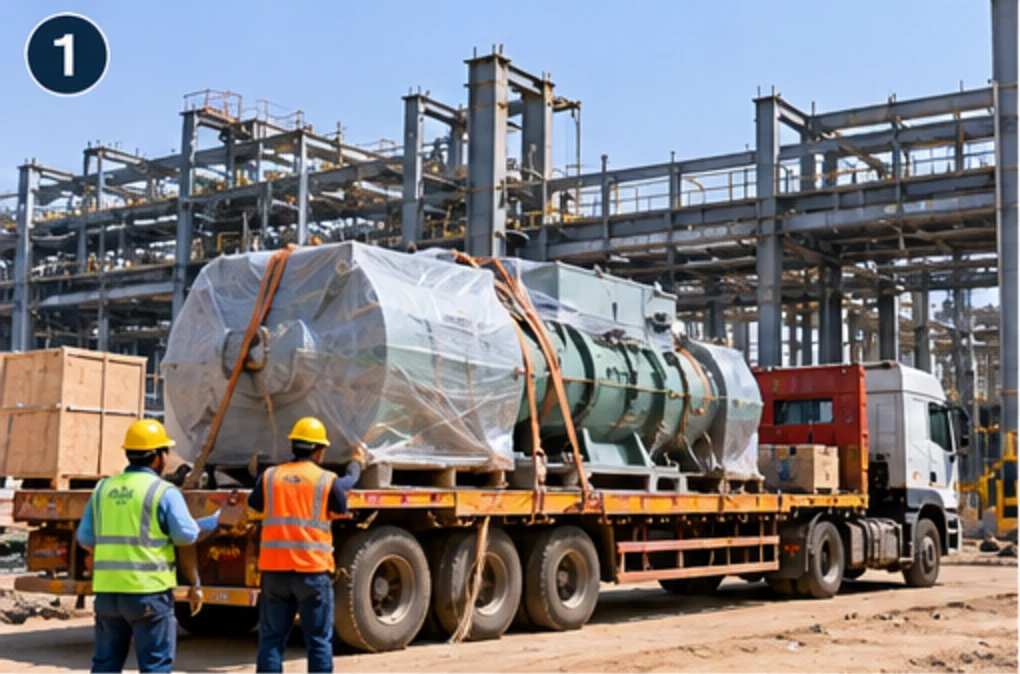
The machine is inspected against the packing list on arrival, machined faces are protected, and anything that will sit for weeks gets a rotation and preservation routine. Damage found now is a claim; damage found at commissioning is an argument.
- 02
Lift plan and positioning
The lift plan fixes the crane position, radius, rigging and the route the machine will travel. It is lifted on the manufacturer lifting points, landed on prepared packing, and stays above the foundation until the base is confirmed fit to receive it.
- 03
Levelling, shimming and grouting
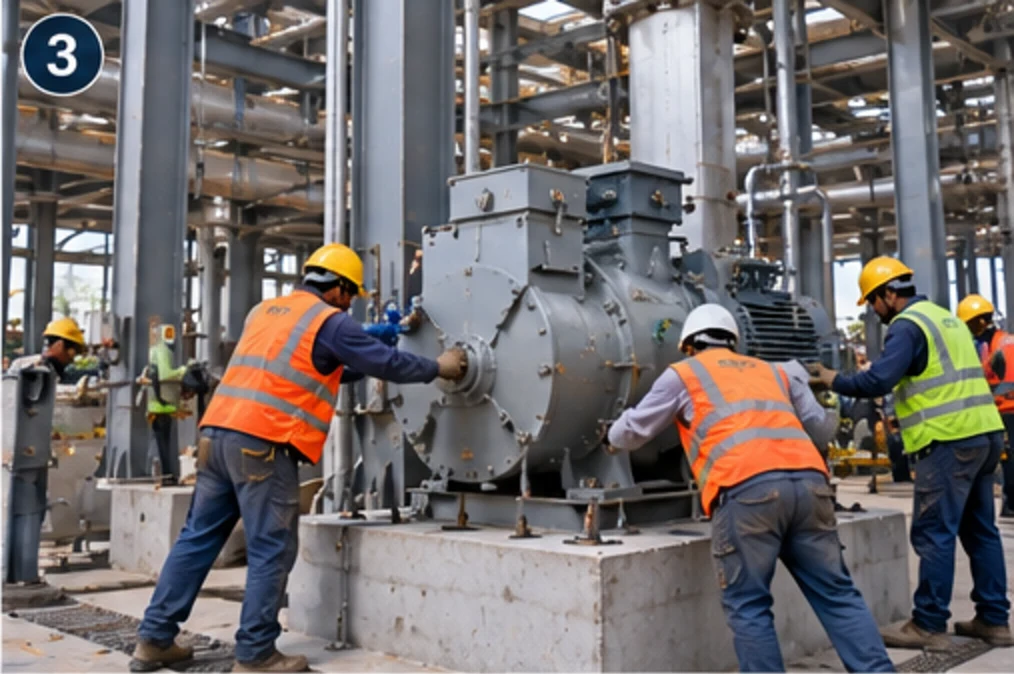
Sole plates and base plate are levelled to the vendor drawing, shim stacks are built solid and grout is placed and cured. Nothing is aligned to a base plate that is not yet supported evenly.
- 04
Soft foot and alignment
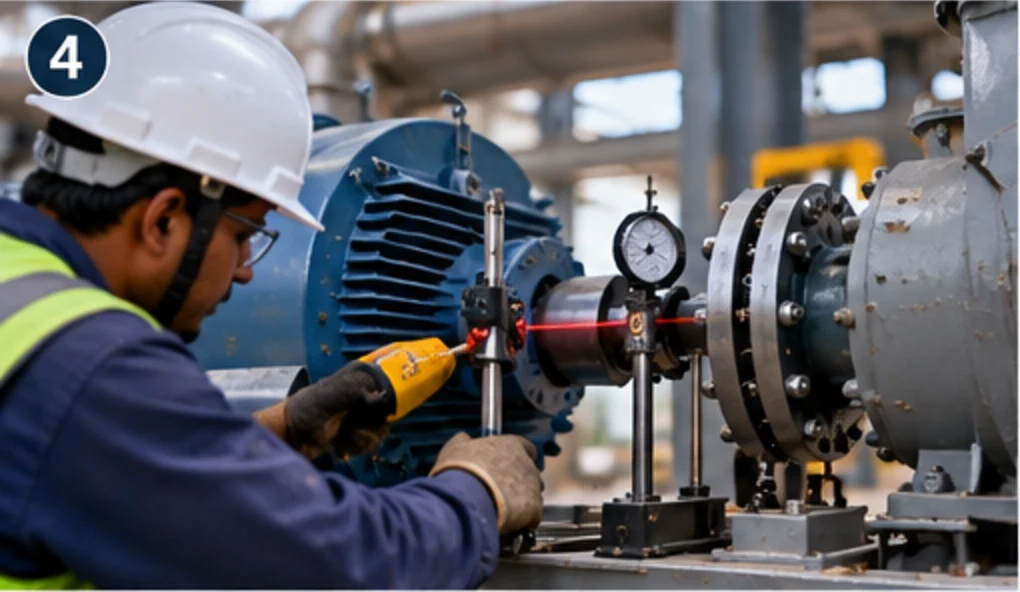
Soft foot is measured at each foot and corrected by shimming. The coupling is then aligned within the vendor tolerance, the readings are recorded, and the machine is re-checked after the piping is connected and after it reaches operating temperature.
- 05
Handover to commissioning
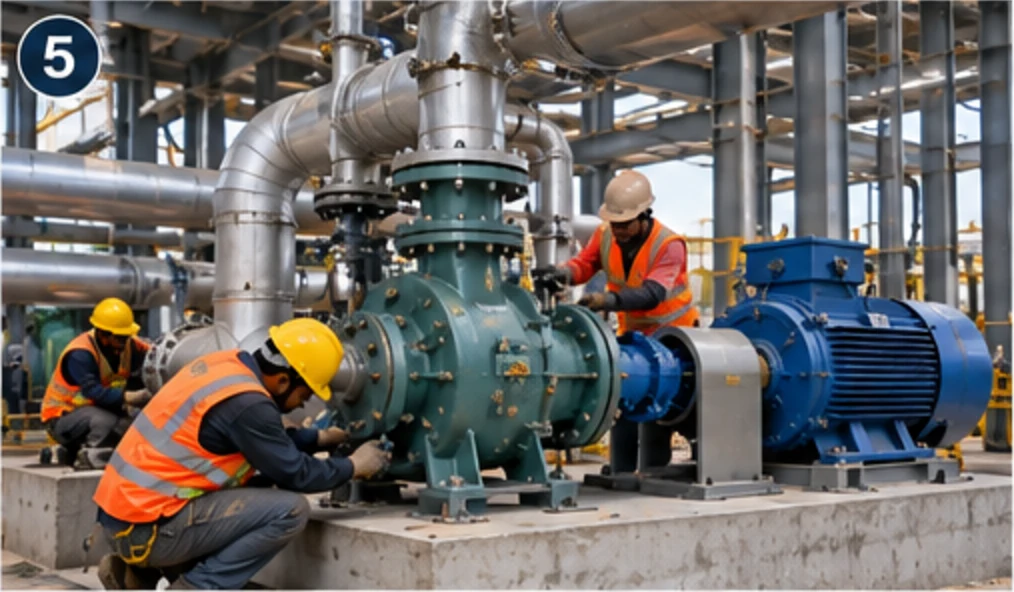
Guards, lubrication and cooling connections are fitted, the vendor checklist is completed, and the records go to the client commissioning team with a closed punch list.
The work, step by step
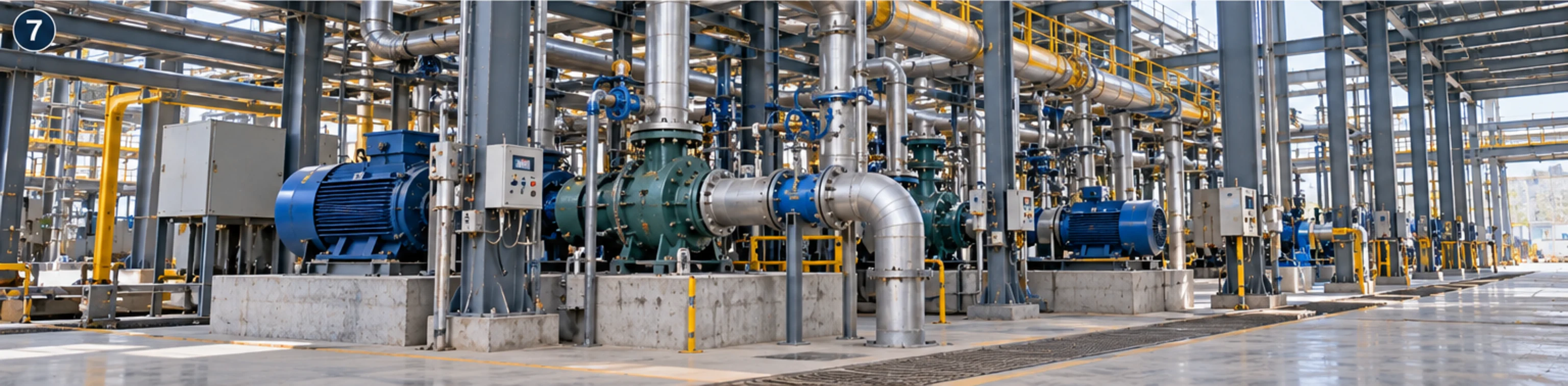
Illustrative images showing the sequence and the type of work involved. They are not photographs of a specific completed AKEN project — for those, see the project photographs.
01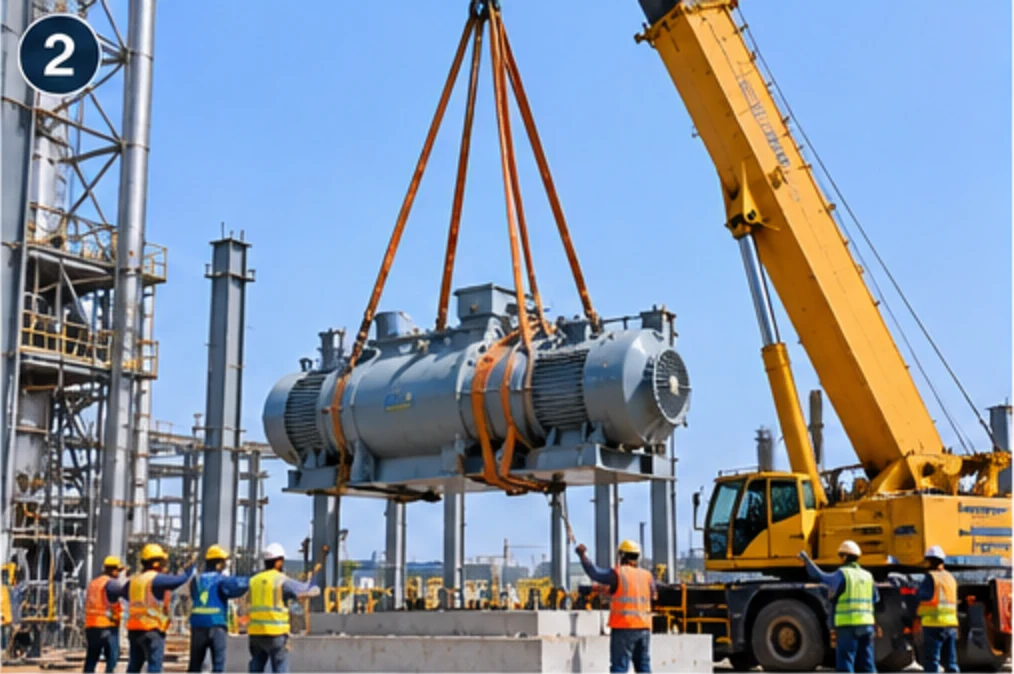 02
 03
 04
 05
 06
 07
Where this is used
We work for plant and procurement teams, EPC contractors and owner-operators across power, cement, mining, manufacturing, warehousing and infrastructure. Much of it is inside a running plant, which sets the terms of the job.
- Process and utility pump houses
- ID and FD fans and air handling equipment
- Blower and compressor rooms
- Cement, mining and material handling plants
- Power plant auxiliaries and cooling water systems
- Effluent and water treatment plants
- Process vessels, exchangers and storage tanks
- Gearboxes, drives and conveying equipment
Why AKEN
Alignment is recorded
Soft-foot readings and cold and hot alignment values are written down and handed over. An alignment nobody measured is an opinion, and it surfaces as a bearing failure in the second month of running.
Fabrication backing on site
Base frames, shim plates, guards, supports and small steel are made in our own shop, so a bracket that does not exist is a day of fabrication rather than a purchase order.
The piping interface is watched
We hold the alignment until the pipe is set to the nozzle rather than pulled to it, and we say so when a pipe run is being forced into a machine. That single check prevents most of the premature failures we are called back to look at.
Live-plant discipline
Isolation, permit to work and shutdown windows are normal conditions for us. The plan is built backwards from the window the client can give, not forwards from our mobilisation date.
Vendor drawing literacy
We work from the manufacturer installation manual, not from memory of a similar machine. Bolt grades, shim limits, grout grades and alignment tolerances are machine-specific and are taken from the document that governs them.
Our safety controls are set out in full at site safety, including the photographs we withdrew because they showed unsafe work.
FAQ
Mechanical Equipment Erection: questions buyers ask
What does mechanical equipment erection cover?
Everything between the machine arriving at site and it being ready for commissioning: receipt inspection, preservation, lifting and positioning, foundation and base plate preparation, shimming, grouting, soft-foot correction, coupling alignment, guards and services, trial run assistance, and the as-installed records. Process commissioning — running the plant and proving the process — stays with the client or the process contractor.
Why is alignment so important for a pump or a fan?
Because misalignment is a load path. If the shafts are not collinear, the coupling and the bearings carry forces the design never accounted for, and the machine starts to fail almost immediately — vibration, seal leakage, hot bearings, a coupling that wears out in weeks. Alignment is also cheap to do properly at installation and expensive to correct after the base plate is grouted and the piping is welded.
What is soft foot and why is it corrected first?
Soft foot is a foot that does not sit flat on its support, so tightening its bolt springs or twists the machine casing. It is found by putting a dial gauge or feeler at each foot with the other bolts tight. Alignment work done before it is corrected is wasted, because the machine moves as the bolts are finally tightened — the readings were of a machine that will not exist once it is bolted down.
When should the piping be connected to the equipment?
After the machine is grouted, soft foot is corrected and the cold alignment is recorded — and the pipe should reach the nozzle without being pulled into place. The final alignment is then re-checked with the piping connected and again at operating temperature, because a pipe that was forced into alignment, or a support that is missing, loads the casing and takes the machine out of line. Pipe supports and expansion joints exist so that thermal movement is absorbed where it is designed to be, not at the equipment nozzle.
Do you carry out the grouting yourselves?
Yes, base plate and sole plate grouting is part of the erection scope, using non-shrink grout to the grade the specification or vendor drawing calls for. Grouting is not a separate trade to us, because the alignment depends on it — the base plate has to be held level and supported evenly while the grout cures, and that responsibility should not sit with a party who is not answerable for the alignment.
Can you install equipment supplied by a vendor who is not on site?
Yes. We install imported and Indian equipment as a matter of routine, working from the manufacturer's installation manual and drawings. What we ask for early is the vendor drawing set, the lifting points, the alignment tolerance, the base plate and anchor bolt details, and the machine weight and centre of gravity — a lift plan cannot be written without them, and guessing at a centre of gravity is how machines get dropped.
How do you lift equipment that has no lifting points?
We do not lift it until a lifting arrangement has been designed for it — usually a fabricated lifting frame or a sling arrangement under the manufacturer guidance, with the load path checked against the casing or the skirt it acts on. Lifting a bare machine on slings chosen by eye risks crushing a casing or finding a point that was never designed to carry the weight, and the damage usually appears only after the machine is running.
What do you need from us before mobilising?
The vendor drawings and installation manual, confirmation that foundations have cured and are released for loading, the equipment weight and centre of gravity, the site access route and lifting area, and the client permit and isolation arrangements. A date for the shutdown window matters too if the tie-in cannot be done with the plant running — the sequence is built around it.
Can equipment be replaced without stopping the whole plant?
Usually yes. Most replacements are planned around an isolated train rather than a full plant stop: the equipment is isolated, the pipe is cut at agreed locations, and the new machine is set and aligned while the rest of the plant keeps running. The constraint is normally flange availability, tie-in points and the number of hours the client can keep that train down — not our crew size.
What records are handed over at completion?
The cold and hot alignment readings, the soft-foot corrections and shim stack details, the grout grade and placement record, the vendor checklist and any deviations we reported, and the punch list status. Those sheets are what a maintenance engineer uses years later to know how the machine was set and whether a later change disturbed it.
Related services
Next step
Have an industrial project in mind?
Discuss your requirement with AKEN. Send the site location, the scope and the date you are working towards, and we will tell you what we need to quote it properly — usually a site visit, scheduled within 72 hours.
+91 82800 76864 · contact@aken.firm.in